The Peat-Free Transition and Why the Timeline Is the Whole Argument
In 2011, the UK government and the horticultural industry agreed a voluntary target to phase out peat from growing media by 2020. In 2020, the target was missed. In August 2022, the government announced a retail ban for 2024. In March 2023, Defra set out a phased approach for the professional sector: reductions from 2026, with a complete ban from 2030. Since then, the debate has continued about whether even 2030 is far enough away, and whether 2026 for commercial growers is too close.
Fifteen years after the first commitment, the policy is still being argued. That tells you something, though not necessarily what the loudest voices on each side want you to hear.
The environmental case for removing peat from horticulture is clear. UK peatlands are the country’s largest carbon store. Extracting peat releases carbon that took thousands of years to accumulate. The retail sector alone accounts for around 70% of peat sold in the UK. The government’s position, stated in March 2023, is that voluntary targets set in 2011 were not successful, and legislation became necessary. That assessment is fair. Progress was made, but not quickly enough.
What is less straightforward is the argument about pace.
Where the Sector Actually Is
The picture on peat reduction is better than either a dismissive “the industry isn’t trying” or an optimistic “we’re nearly there.” Professional peat use is already below 50% of previous levels. Bagged compost for the retail market has come down to around 30% peat content. Sectors with more straightforward alternatives, such as strawberry and other soft fruit growers, have already transitioned. The HTA describes this as an historic low. That progress happened because the industry accepted the direction of travel and invested in alternatives before legislation arrived.
What has not happened is a complete solution for all plant types. Some crops are genuinely difficult. The propagation stage, particularly for young plants in small plugs, is where alternatives have been hardest to develop at a commercial scale. Defra acknowledged this directly in the March 2023 policy, carving out technical exemptions for plugs with a maximum volume of 150ml and for edible mushroom production. Conservation exemptions, where peat is necessary for vulnerable or endangered plant species, carry no end date.
Those exemptions exist because the R&D work is still running. You cannot run commercial-scale trials on thousands of plant species, identify peat-free mixes that perform reliably, adjust irrigation and nutrient regimes, train staff on new production techniques, and reconfigure infrastructure in one or two growing seasons. Biology does not care about policy timelines.
What Bringing the Deadline Forward Would Actually Mean
In April 2023, when Defra signalled its intention to bring the commercial ban forward from 2030 to the end of 2026, the HTA ran a member survey. The responses came from 69 grower businesses with a combined crop value of £227 million, and 122 retailers with an annual turnover of £655 million.
The headline finding: commercial growers projected a shortage of around 100 million plants and trees for sale in the year immediately following an accelerated ban. The UK’s commercial plant growers produce plants, trees, bulbs, and flowers worth £1.6 billion annually and employ around 18,000 people. If output fell by 10-15% in the year after a rushed deadline, the HTA estimated close to 3,000 job losses in production alone, before any knock-on effects in garden retail and landscape services.
The numbers behind that headline are what make it credible. Sixty-six percent of commercial growers said they would likely need more water to produce the same volume of plants using peat-free alternatives they had not yet fully tested. In a context where UK water stress is increasing and growers are already under pressure on abstraction, forcing a shift to unproven growing media that happens to be more water-intensive is not obviously a net environmental gain. Nine percent of commercial growers said the 2026 deadline would likely be commercially unviable and force closure.
The comparison Defra offered was that bringing the ban forward four years would save approximately 278,000 tonnes of CO2 equivalent. Set against the loss of 100 million plants and trees, many of which are themselves carbon sinks, that trade-off is not as clean as the headline carbon number suggests.
The Houseplant Problem Nobody Talks About
There is a specific issue within the peat debate that receives less attention than it deserves. Around 23 million people in the UK buy houseplants each year. Garden centres that sell houseplants estimate that 87% of what they stock is imported. Overseas producers are considerably more reliant on peat than UK growers, and most are not subject to UK legislation.
A ban on UK professional peat use that drives houseplant production further toward imported stock does not remove that peat from the supply chain. It relocates the extraction. The carbon still gets released, just not in England. Meanwhile, UK growers producing plants in peat-based media lose business to imports that face no equivalent restriction.
The HTA survey found that garden centres anticipated houseplant sales would fall by 70% if the accelerated 2026 deadline came in, largely driven by import dependency. Whether or not that projection proves accurate, the direction of travel is already visible: a UK peat ban without equivalent import standards does not remove peat from the supply chain. It shifts extraction offshore while damaging domestic producers.
What It Looks Like in Practice
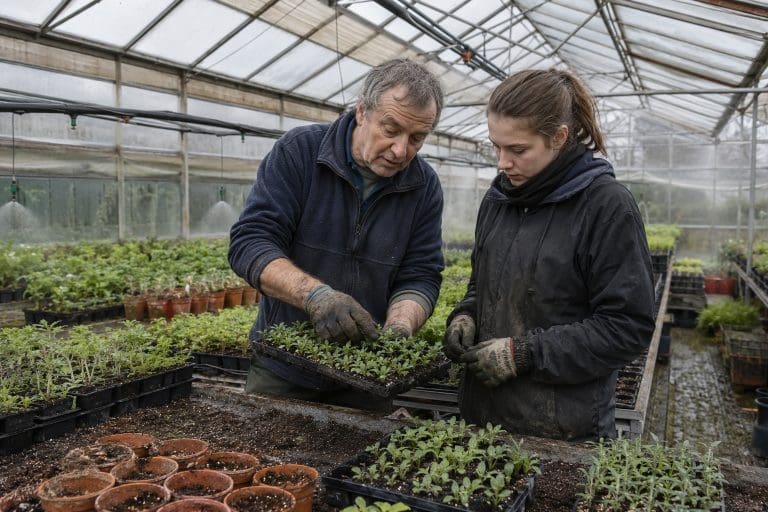
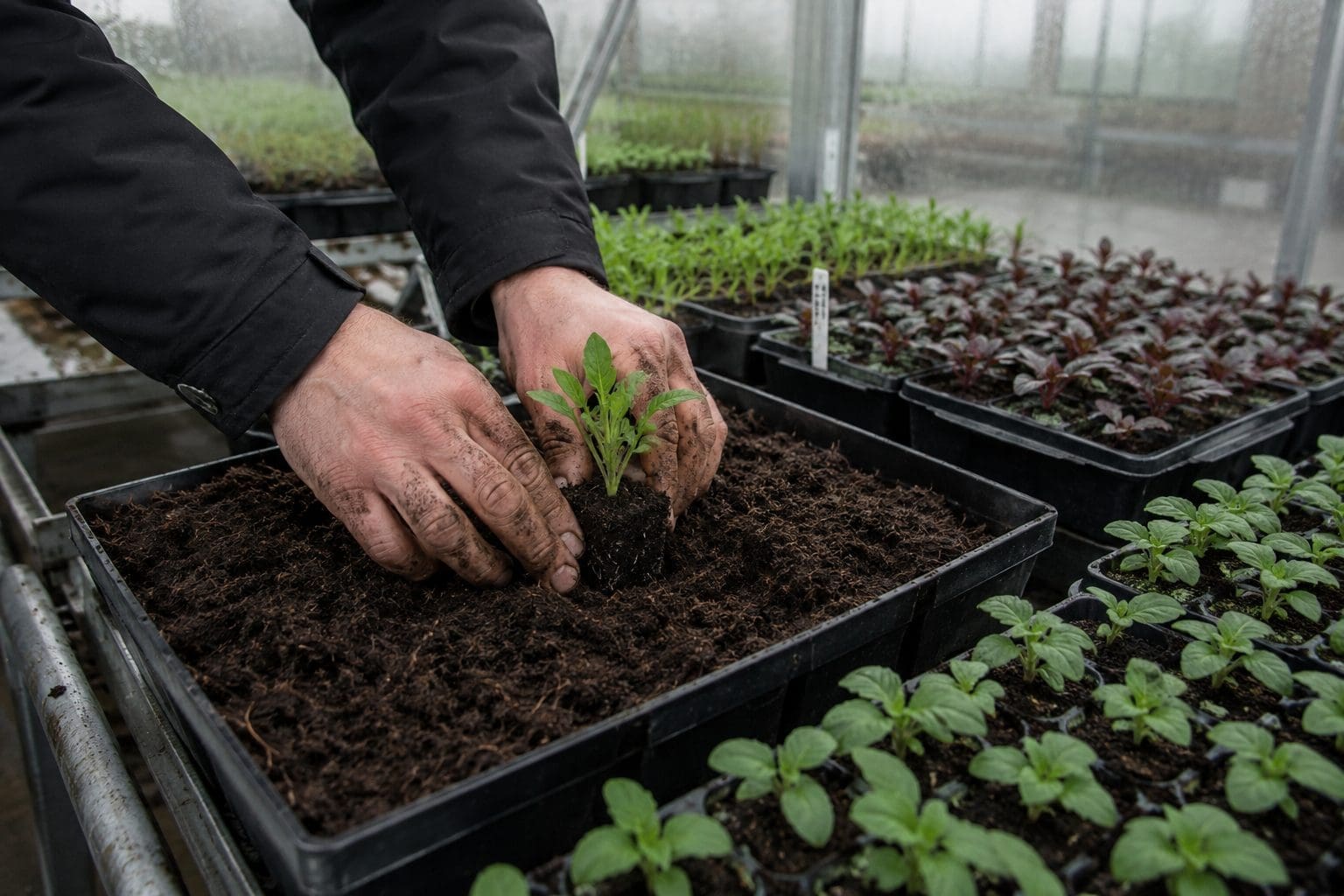
I have been growing peat-free on my allotment and in my growing spaces for a number of years. For most of what I grow from seed, a good peat-free mix works. Vegetable seedlings, herbs, and most annual flowers. The results, once you adjust watering, are comparable. It took some learning. I have had bags of peat-free compost that behaved well, and others that dried out on top while staying wet underneath. That is manageable when you have a few trays on an allotment bench. It is a different matter entirely when a nursery has thousands of plug plants and a watering system built around predictable media. But for what I do at a non-commercial scale, the transition was manageable.
The growers I talk to through Simplify Gardening and HortTrack are working at a different scale. They are not asking whether peat-free is possible. Most have already accepted it is. They are asking whether the timing allows them to get the propagation right for their specific crops, whether a reliable supply of quality peat-free media at commercial volume is available when they need it, and whether their irrigation systems can handle the shift without significant capital outlay. Those are not arguments against the destination. Those are arguments about the road.
The sector that was given ten years from 2011 to meet a voluntary target and did not hit it was not acting in bad faith. The replacement growing media at the scale required were not ready. Some still are not, for specific crops and applications. That is the honest position. The question for policy is whether 2030 gives the remaining hard cases enough time to catch up, or whether more support, shared R&D funding, and infrastructure investment would bring forward the genuine transition faster than a deadline alone.
What a Workable Approach Requires
The exemptions in the current 2030 framework exist because science set the pace, not the politics. A conservation exemption with no end date is an acknowledgement that, for some plant species, no alternative currently exists. The plug exemption, set at 150ml maximum volume, is a practical concession to propagation reality.
What is missing from the policy picture is a clearly funded R&D programme that accelerates the development of alternatives for the remaining problem cases, so that the exemptions can be closed as solutions become available rather than persisting indefinitely. The industry has done considerable voluntary work on this. The Defra media blog from March 2023 acknowledged that the government has jointly funded some research on peat replacements. But “jointly funded some research” and “a funded programme with actual targets, timelines, and accountability” are different things.
The sector has demonstrated that it can reduce peat use when alternatives exist and when commercial-scale production techniques are understood. Professional use has halved. Retail bagged compost is at 30%. That is genuine movement. The 2030 date was accepted by the HTA as “challenging” but achievable. Bringing it forward without the infrastructure to support it risks producing neither a faster transition nor a better environmental outcome. It risks producing plant shortages, an increase in peat-grown imports, and business closures, with extraction continuing at similar volumes elsewhere.
That is not a good deal for peatlands, for growers, or for the 23 million people who buy houseplants.
Sources: Defra media blog: Media reporting on peat ban for the professional horticulture sector (March 2023). HTA: The horticultural industry warns of plant shortages for UK gardeners by 2027 if a ban on peat is brought forward (April 2023). HTA: Peat. England Peat Action Plan: GOV.UK.